59. Unveiling the Potential of Magainin Derivatives against Candida Species
Abstract:
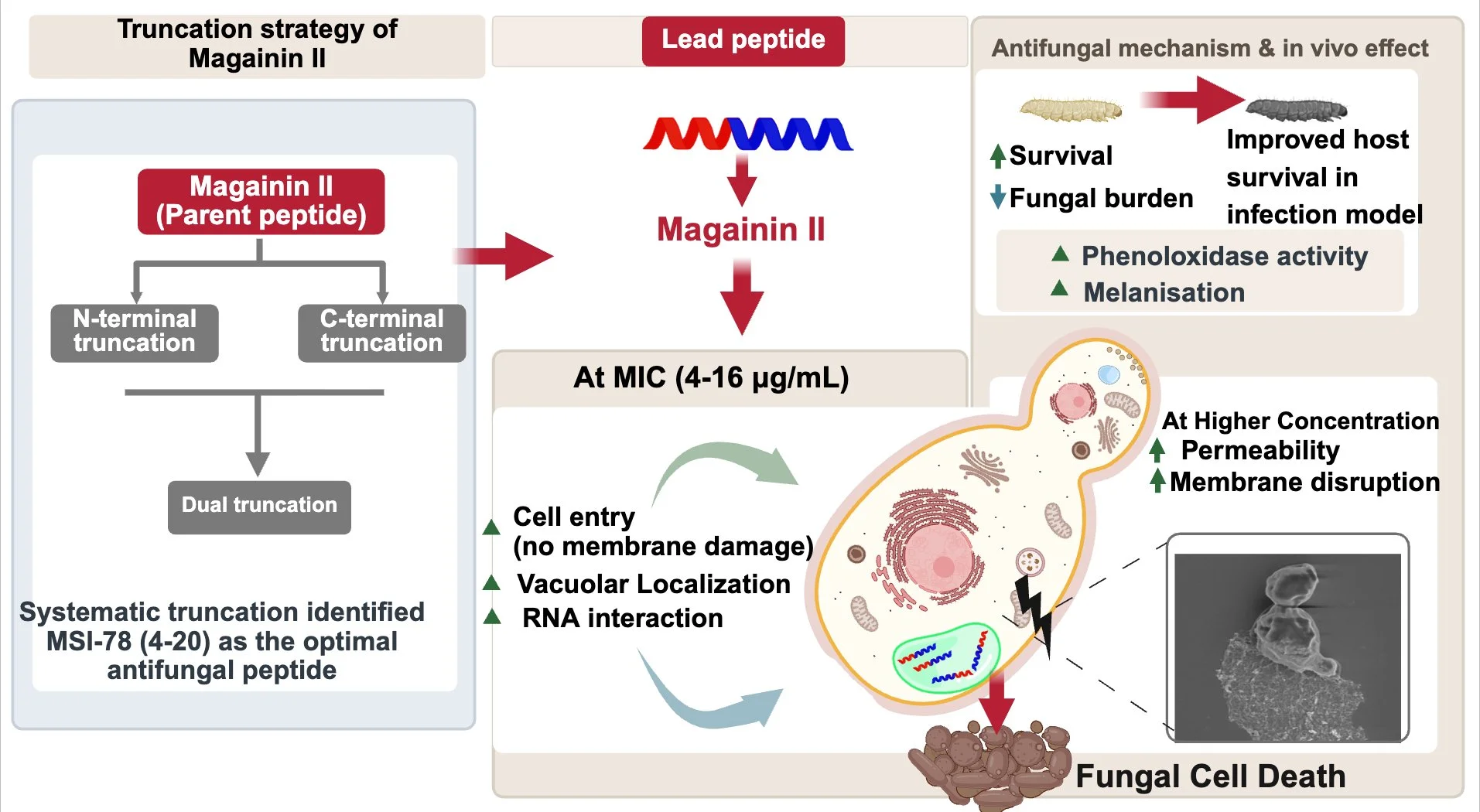
The increasing antifungal resistance, including Candida albicans resistance, highlights the urgent need for novel antifungal agents. Antimicrobial peptides are promising alternative antimicrobial agents, but most work focuses on antibacterial studies, including Magainin II and its derivative Pexiganan (MSI-78). Here, we evaluated a Pexiganan peptide library and identified MSI-78 (4–20) as a lead-hit antifungal agent against multiple Candida species, including fluconazole-resistant C. auris isolates. Importantly, it improved survival and reduced fungal burden in C. albicans-infected Galleria mellonella, suppressing phenoloxidase activity and melanization. Mechanistically, it entered cells at 16 μg/mL with limited membrane damage, whereas 32 μg/mL caused membrane disruption and intracellular leakage. Transcriptomics revealed activation of stress-response and cell-surface remodeling, with repression of carbon metabolism and respiration. These findings indicate a concentration-dependent mixed mode of action combining metabolic stress at lower exposure and membrane disruption at higher concentrations. MSI-78 (4–20) therefore represents a magainin-derived scaffold for antifungal development.
Tianmeng Zhang, Jinxin Zhao, Praveen Praveen, Kathy Parisi, Yujie Zhu, Dhammika Leshan Wannigama, Shang-Yi Lin, Tep Reasmey Vong, Meet Parmar, Jian Li, Marilyn A. Anderson, Wenyi Li*; Unveiling the Potential of Magainin Derivatives against Candida Species. J. Med. Chem. 2026 (corresponding author) DOI: 10.1021/acs.jmedchem.6c01330