17. (Re)Defining the Proline-Rich Antimicrobial Peptide Family and the Identification of Putative New Members
As we rapidly approach a post-antibiotic era in which multi-drug resistant bacteria are ever-pervasive, antimicrobial peptides (AMPs) represent a promising class of compounds to help address this global issue. AMPs are best-known for their membrane-disruptive mode of action leading to bacteria cell lysis and death.

16. Chemical Modification of Cellulose Membranes for SPOT Synthesis
Since the development of solid-phase peptide synthesis in the 1960s, many laboratories have modified the technology for the production of peptide arrays to facilitate the discovery of novel peptide mimetics and therapeutics. One of these, known as SPOT synthesis, enables parallel peptide synthesis on cellulose paper sheets and has several advantages over other peptide arrays methods.
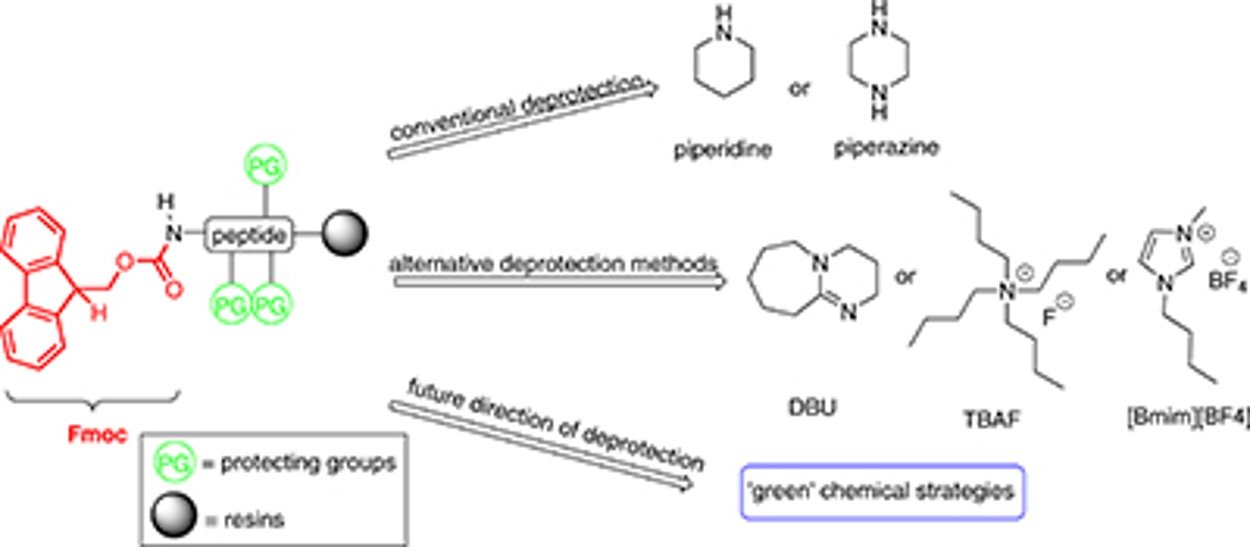
15. The 9-Fluorenylmethoxycarbonyl (Fmoc) Group in Chemical Peptide Synthesis – Its Past, Present, and Future
The chemical formation of the peptide bond has long fascinated and challenged organic chemists. It requires not only the activation of the carboxyl group of an amino acid but also the protection of the Nα-amino group.
14. Effect of Dimerized Melittin on Gastric Cancer Cells and Antibacterial Activity
Melittin is the peptide toxin found in bee venom and is effective against cancer cells. To enhance its activity, a branched dimeric form of melittin was designed. The monomeric form of the peptide was more cytotoxic against gastric cancer cells at low concentrations (1–5 μM) than the dimer form, while the cytotoxic effect was comparable at higher concentrations (10 μM).

13. Covalent Conjugation of Cationic Antimicrobial Peptides with a β-lactam Antibiotic Core
To combat the serious issue of increasing global antibiotic resistance, new antimicrobial therapies are urgently required. As one alternative, previously used antibiotics are being investigated for use in combination with more modern antibiotics including antimicrobial peptides.
12. The Effect of Selective D- or Nα-Methyl Arginine Substitution on the Activity of the Proline-Rich Antimicrobial Peptide, Chex1-Arg20
n vivo pharmacokinetics studies have shown that the proline-rich antimicrobial peptide, A3-APO, which is a discontinuous dimer of the peptide, Chex1-Arg20, undergoes degradation to small fragments at positions Pro6-Arg7 and Val19-Arg20. With the aim of minimizing or abolishing this degradation, a series of Chex1-Arg20 analogs were prepared via Fmoc/tBu solid phase peptide synthesis with D-arginine or, in some cases, peptide backbone Nα-methylated arginine, substitution at these sites.

11. Fluorescent Ion Efflux Screening Assay for Determining Membrane-Active Peptides
A major global health threat is the emergence of antibiotic-resistant microbes. Coupled with a lack of development of modified antibiotics, there is a need to develop new antimicrobial molecules and screening assays for them.

10. C-Terminal Modification and Multimerization Increase the Efficacy of a Proline-Rich Antimicrobial Peptide
Two series of branched tetramers of the proline-rich antimicrobial peptide (PrAMP), Chex1-Arg20, were prepared to improve antibacterial selectivity and potency against a panel of Gram-negative nosocomial pathogens including Escherichia coli, Klebsiella pneumoniae, Acinetobacter baumannii and Pseudomonas aeruginosa.

9. Membrane Interactions of Proline-Rich Antimicrobial Peptide, Chex1-Arg20, Multimers
Highlights
· Proline-rich antimicrobial peptides (PrAMPs) exhibit different mechanisms in vesicles and live bacteria.
· The designed PrAMP, Chex1-Arg20, and its oligomers did not induce dye leakage in model membranes.
· Chex1-Arg20 oligomers showed stronger binding to anionic phospholipid bilayers and led to liposome aggregation.

8. Multimerization of a Proline-Rich Antimicrobial Peptide, Chex-Arg20, Alters Its Mechanism of Interaction with the Escherichia coli Membrane
Highlights
•Multimers of the proline-rich antimicrobial peptide, ChexArg20, were prepared
•Increase in peptide valency alters its Escherichia coli membrane interaction
•Change is from membrane non-lytic to membrane disruption
•There is also simultaneous change from membrane hyperpolarization to depolarization